There's a special kind of heartbreak reserved for loading up Portal 2's co-op campaign and realizing your gaming buddy isn't available. What should be a triumphant robot ballet becomes a stark reminder that some of gaming's greatest achievements are locked behind the simple requirement of having another human being around. This is the sidekick tax in action — the hidden cost of brilliant co-op design that leaves solo players out in the cold.
As couch co-op stages its comeback in 2026, this design challenge has never been more relevant. Developers are rediscovering the magic of shared-screen experiences, but they're also grappling with an uncomfortable truth: the better a co-op boss fight is, the worse it often feels when you're flying solo.
The Anatomy of Perfect Partnership
Portal 2's co-op campaign remains the gold standard for collaborative boss design. Every encounter is built around the fundamental principle that two players can achieve what one cannot. The final boss requires precise timing, spatial reasoning, and trust that simply cannot be replicated with AI companions or solo play mechanics.
When ATLAS and P-body work in perfect synchronization to solve GLaDOS's deadly puzzles, it feels like digital poetry. Portal placement becomes a conversation between players, where success depends not just on individual skill but on developing a shared language of cooperation. The boss fights aren't just challenging — they're intimate.
But fire up that same sequence solo, and the magic evaporates. The AI companion, no matter how sophisticated, can't replicate the intuitive understanding that develops between human players. What was once a dance becomes a series of awkward, predetermined movements.
A Way Out faces this problem head-on by making co-op mandatory. The entire game is designed around the assumption that two people are playing together, from split-screen cinematics to boss encounters that literally require four hands. It's a bold design choice that eliminates the sidekick tax entirely — but at the cost of accessibility.
The AI Companion Compromise
Most developers try to split the difference with AI companions that can fill the second player slot. The results range from serviceable to frustrating, but rarely capture the magic of human cooperation.
Army of Two built its entire identity around buddy cop mechanics, with boss fights designed for coordinated aggro management and synchronized takedowns. The AI companion is competent enough to keep the fights functional, but it reduces what should be dynamic strategy sessions to following predetermined scripts.
The Borderlands series handles this challenge better than most by designing encounters that scale naturally between solo and co-op play. Boss health pools adjust automatically, and most mechanics can be handled by a single skilled player. But even here, the sidekick tax is real — fights like the Warrior or Handsome Jack are simply more engaging when you have teammates to revive you and coordinate elemental combinations.
It Takes Two represents the current pinnacle of co-op boss design, with encounters that feel genuinely impossible without a partner. The divorce counseling metaphor extends to every boss fight, where success requires not just coordination but actual communication and compromise. It's brilliant design that completely eliminates the possibility of solo play — a radical solution to the sidekick tax that works because it commits fully to the concept.
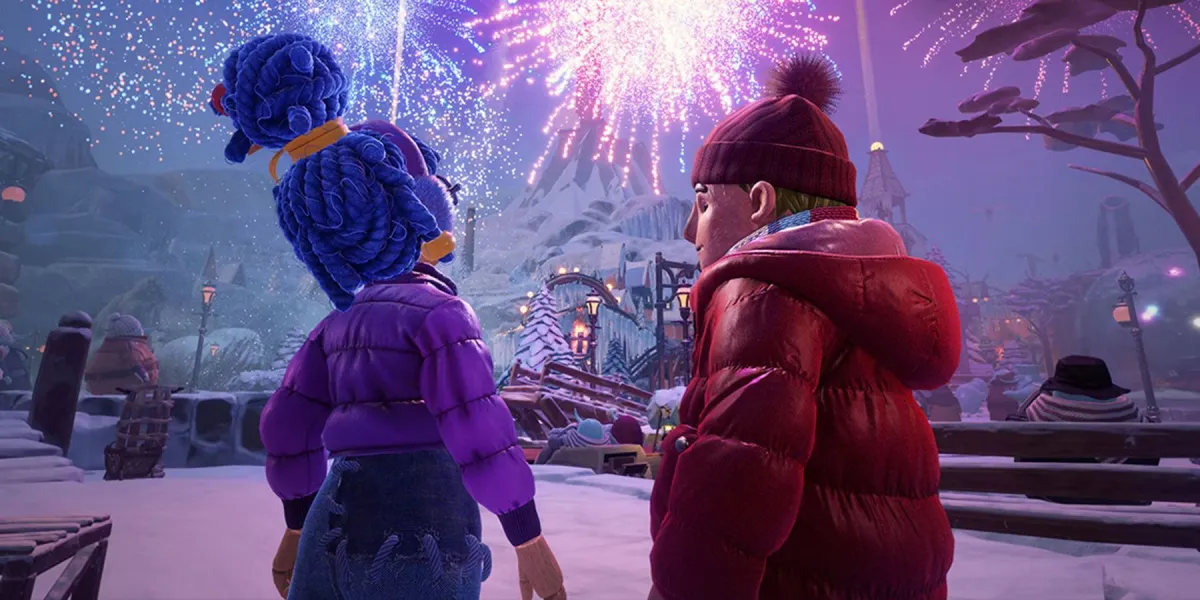 Photo: It Takes Two, via static1.cbrimages.com
The Scaling Nightmare
Developers who try to make co-op bosses work for both solo and multiplayer face an almost impossible balancing act. Scale the difficulty too far down for solo players, and co-op becomes trivial. Keep the challenge high, and solo players hit a brick wall.
Destiny 2's raid bosses exemplify this challenge. Encounters like Atheon or Oryx are masterpieces of coordination-based design, requiring precise timing, role assignment, and communication. But the game's solution is simply to lock these encounters behind mandatory multiplayer — there is no solo option.
This approach works for live-service games with active communities, but it highlights the fundamental tension in co-op design. The most memorable boss fights often require genuine human cooperation that can't be faked or automated.
Diablo 4 tries a different approach, scaling boss difficulty dynamically based on party size while maintaining the core mechanics. It's a technical achievement, but it often results in encounters that feel perfectly adequate in any configuration without excelling in any particular one.
The Couch Co-Op Renaissance
As local multiplayer experiences a resurgence in 2026, developers are rediscovering the unique intimacy of shared-screen boss fights. Games like Cuphead prove that some experiences are simply better when you can elbow your co-op partner in real life.
The Cuphead bosses are designed around the assumption that two players will share the challenge and the screen space. Success often comes down to one player creating openings while the other capitalizes, or coordinating movement patterns that would be impossible to communicate through voice chat alone.
But here's where the sidekick tax hits hardest: Cuphead is brutally difficult solo. Bosses designed for two players to split attention and damage output become endurance tests when faced alone. The game doesn't scale difficulty down significantly, leaving solo players to master encounters that were never really meant for them.
Overcooked takes a different approach, making the chaos of multi-player cooperation the point rather than the challenge. Boss-level kitchen scenarios become exercises in controlled panic, where success depends on developing efficient workflows under pressure. Solo play is possible, but it transforms the experience from collaborative comedy into a stressful time-management simulation.
The Future of Shared Struggle
As we move into 2026, developers are experimenting with new solutions to the sidekick tax. Asymmetric co-op design is gaining traction, where players have fundamentally different abilities and perspectives.
We Were Here series pioneered this approach with puzzle-based boss encounters where players literally can't see the same information. One player might see the boss while the other sees the solution, forcing genuine communication and trust. It's a design that makes solo play impossible not through artificial barriers, but through fundamental mechanical requirements.
Cloud gaming and improved AI are opening new possibilities for dynamic companion systems. Imagine AI that learns from successful co-op sessions, gradually developing the intuition and unpredictability that makes human partners so effective.
But perhaps the most promising development is the growing acceptance that some experiences are meant to be shared. Rather than trying to make every boss fight work for every possible player configuration, more developers are embracing the idea that co-op bosses should be uncompromisingly designed for cooperation.
The Price of Partnership
The sidekick tax isn't a bug in co-op design — it's a feature. The loneliness of playing a brilliant co-op boss fight solo serves as a reminder of what we're missing when we game alone. These encounters are love letters to the idea that some challenges are meant to be shared, some victories are sweeter when celebrated together.
As gaming becomes increasingly connected yet paradoxically isolated, co-op boss fights that embrace the sidekick tax serve an important function. They force us to reach out, to coordinate, to trust another person with our virtual lives. And sometimes, the tax is worth paying for the reminder that the best battles are the ones we don't fight alone.